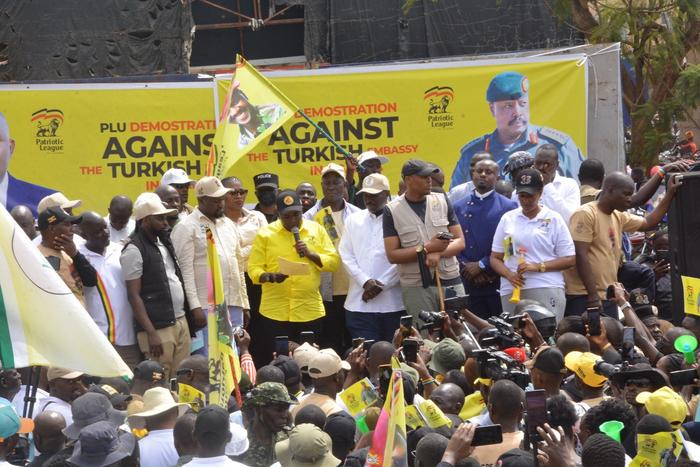
A snap demonstration by supporters of the Patriotic League of Uganda (PLU) intended as a “diplomatic prank” and staged at the Turkish embassy in Kampala has sent tremors in Ankara. While the action is being talked about as far away as Azerbaijan, the entire Middle East, whole of Africa, parts of Europe and USA, in Turkey it appears to have sent an unequivocal message that is making the authorities there reconsider their attitude towards many things.
Their apologists have quickly come up to weigh the finality with which the demonstrators acted and determined that it was beyond the stated purpose. They claim that it was a fight over a huge paycheck from the Somalia peace mission which they claim has been reassigned from Uganda to themselves, and that the demonstration was aimed at exerting pressure on Ankara for it. How ridiculous!
When calling the protest, it was stated clearly that it was intended to express anger at Turkey ‘s failure to cooperate in extraditing a dissident commentator who has made a name insulting the Ugandan establishment and spreading vitriol against its leaders, particularly Gen. Muhoozi Kainerugaba, Chief of Defence Forces (CDF) and President Yoweri Museveni, while posing as an opposition activist. This internet mole going by the name Fred Kajubi Lumbuye has, for years, piled so much scorn and slander that nobody world over, let alone a leader, would tolerate such an extent of character assassination and incitement against oneself without pushing back. The demonstration was long in coming, attributable, mostly, to President Museveni’s distinguishing thick skin.
Certainly, it’s a task to find someone in Turkey who would tolerate the kind of affront represented by Lumbuye daily. Had he been a Turk based in Uganda saying the same things about the leaders in Ankara, the home country would have taken care of him without a remedy possible on his side (re-read that!)!
But Gen. Muhoozi and his PLU group of which he is the chairman, chose to express displeasure in a democratic way-by protesting, peacefully, while working out other ways to bring the matter to a conclusion. This was a normal exercise in activism called by an aggrieved group of citizens in response to daily and ceaseless provocations.
Nobody stages street action as a mechanism to exert pressure for a multimillion dollar peacekeeping multinational operation. Here is why: how did the mission to Somalia start? It was an international response to the insecurity situation that threatened to shred Somalia apart and spread to the neighbouring region. It started as African Union Mission to Somalia (AMISOM), later morphing into the African Union Support and Stabilization Mission in Somalia (AUSSOM).
The international community organised a military expedition to stabilise the battered country that fell apart starting in 1991 when rival groups started dividing its carcass. Uganda, buoyed by accumulated experience of fighting different rebellions at home and serving in peacekeeping missions all over Africa, offered (or was selected) to deploy its troops on behalf of the international community-later joined by Burundi, Kenya, etc. The international community,through the UN, was to meet the cost of the mission, and this has been the arrangement since 2007.
Nineteen years later, Somalia has been salvaged from a state of near disintegration, stabilised and now talk is that it’s stable enough to manage its security needs and grow its systems. In short, Somalia is a nation again and Al-Shabaab may be nearing its end.
If, indeed, that’s the state of affairs prevailing today, it means that the AMISOM/AUSSOM mission was a success, thanks to the deploying countries and funding partners. If it has been determined that the mission’s objectives have been achieved, then it is up to the partners to discuss any new developments that would determine the way forward. Such arrangements are not done through demonstrations but boardroom deliberations. To claim that the Kampala demonstration was about the fate of this mission is to exhibit an extraordinarily low level of knowledge of diplomatic and foreign relations.
Then, why would the demonstration be held at the Turkey embassy , not that of USA or the UN mission, since they have greater say in these missions, more so in regard to the so-called “paycheck” which is claimed to be the prize that the Uganda government is panicking to salvage? If that paycheck is such a big deal and if Uganda didn’t exist before it came, the Uganda government is well-versed with processes and procedures of negotiating for such support if needed. It need not come through a direct ground troop deployment. It can be included in the portfolio of longstanding military support to Uganda since the country remains a strong and reliable security partner in the Great Lakes region, and beyond.
Just recently, Uganda was invited to join the peacekeeping mission in Gaza and under the auspices of the Board of Peace, an organisation chaired by US President Donald Trump. That talks of capacity, thattalks of unshakeable partnership! Of the Gaza operation and the Somalia one, which one is moreconsequential at this time?
If the Mogadishu mission is over, the participating countries deserve appreciation for the immense sacrifice and courage for their role, not mockery. Particularly, driven by the spirit of brotherhood and enduring Pan-Africanism, Uganda went in when the situation was so untenable and risky, at a cost of lives of hundreds of its own troops and risk of infiltration by vengeful Al-Shabaab into its territory back home. There were no strings attached; just a desire to see the Somali people live in peace and dignity again.
If other players came in with a business mind and other motivations, that was possible because of the seed planted by the Ugandans. The initial deployment opened the door for other players to come in and contribute to Somalia’s turnaround. This is a very delicate and far-reaching step that can’t be reduced to mere “paychecks” and “demonstrations”. Somalia’s stability means more to Africans than anything that money can buy. This is why more and more, Africans should develop their own capacity to address their continental issues, and even serve on the world stage when need arises while placing humanity above financial motivations.
While Ankara was misrepresenting the Kampala demonstration’s objectives, Lumbuye was acknowledging that, indeed, he was the target. He does not deny that he has been maligning the Uganda government and spreading malicious content against President Museveni, Gen. Muhoozi, the first family, NRM ruling party and anybody who isn’t of a similar ethnicity like him. There is no question that both Lumbuye and Muhoozi are at each other’s neck, applying different methods to try and defeat the other.
It is possible that Gen. Muhoozi uncovered a scheme to use Lumbuye in attacking and undermining the Ugandan regime as part of a clandestine plan to buoy opposition in causing regime change in Kampala, counting on gaining an upper hand in Somalia if a new and amateur regime took over, from where they could plan broader actions all over Africa.
By staging that demonstration and suspending military cooperation with Turkey as announced soon after, Muhoozi has drawn attention to unspoken and unseen schemes surrounding the involvement of some foreign actors on African soil. Their goals may not be limited to undermining homegrown capacity to run continental affairs and threatening our collective sovereignty anew.
On the issue of whether the demonstrators were paid, those alleging so should sit and agree on the figure; Lumbuye says they were paid 30, 000 Uganda shillings while an article by one of Ankara’s agents says they were paid between five and six dollars (Shs18,500 and Shs22,200). Which is which? It should be noted that the September 18 protest was intended to be exemplary. Had PLU intended it to be an all-out showdown, millions of its supporters would have poured out. But it wasn’t necessary. Just a few hundreds and capitals are quaking.